Show solutionHide solutionx→∞lim(1−xπ)2x=x→∞lim[(1+−πx1)−πx]−xπ⋅2x=e−xπ⋅2x=e−2π
Example 1.2
Solve x→0limx1log(1−x1+x)
Show solutionHide solutionx→0limx1log(1−x1+x)=x→0limlog((1−x1+x)x1)=x→0limlog((1−x1+x+x−x)x1)=x→0limlog((1−x1−x+x+x)x1)=x→0limlog((1−x1−x+1−xx+x)x1)=x→0limlog((1+1−x2x)x1)=x→0limlog[(1+1−x2x)2x1−x]1−x2x⋅x1=x→0limlog(e1−x2x⋅x1)=x→0limlog(e1−x2)=log(e1−02)=log(e2)=2
Cauchy Criterion
Definition 2.1Cauchy sequence
A sequence (an)n∈N is called a Cauchy sequence if:
∀ε>0,∃N=N(ε)∈N:∣an−am∣<ε,∀n,m>N.
SatzCauchy criterion (3.5.1)
Let (an)⊂R be a sequence. The following statements are equivalent:
(an) is convergent
(an) is a Cauchy sequence.
Example 2.1
Is the sequence 2nn−1 convergent?
Show solutionHide solution
We choose an (arbitrarily small) ε>0. We look for N such that ∣an−am∣<ε for all m,n>N. W.l.o.g. (without loss of generality) we can fix m≥n (or n≥m).
The sequence an is therefore a Cauchy sequence, and since all Cauchy sequences in R converge, our sequence is convergent as well.
Subsequences, Accumulation Points
Definition 3.1
Let (an)n∈N⊂R and let ℓ:N→Λ⊂N,n↦ℓ(n), be a strictly monotonically increasing sequence of natural numbers.
The composition (aℓ(n)) of ℓ(n) and an is called a subsequence of an.
Remark
It is important here that Λ contains infinitely many elements. If Λ were finite, you would not get a subsequence at all, just a list of finitely many numbers!
Example 3.1
Let (an)n∈N=(−1)n be a sequence in R. Then, among others, there are the following two subsequences:
a∈R is called an accumulation point of (an)n∈N if (an)n∈N has a subsequence (aℓ(n)) converging to a. That is, there is a subsequence (aℓ(n)) with
ℓ(n)→∞limaℓ(n)=a.
SatzBolzano-Weierstrass (3.4.1)
Every bounded sequence (an)n∈N in R has a convergent subsequence, and hence also an accumulation point.
Remark
an boundedan bounded⇏an converges⟹Bolzano-Weierstrass∃ subsequence (aℓ(n)) that converges.
Limit Superior and Limit Inferior
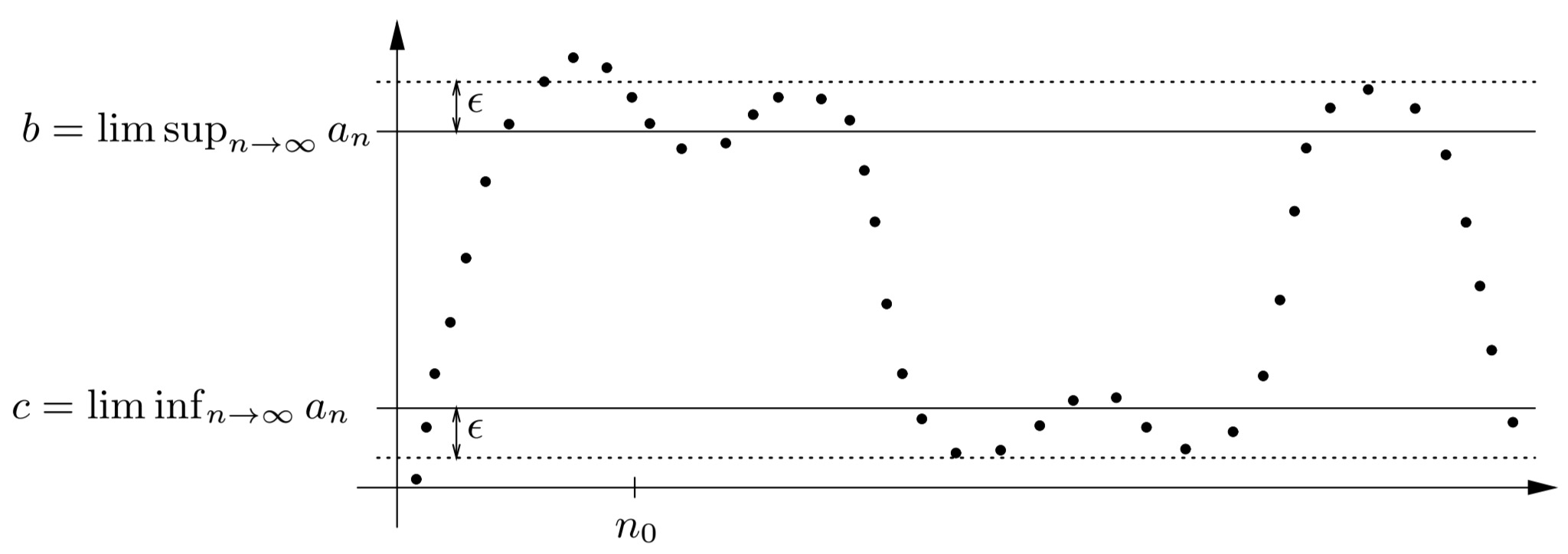
Definition 4.1limit superior and limit inferior
Let (an)n∈N be bounded, i.e.
∃M∈R,∀n∈N:∣an∣<M.
Then, for k∈N, by the theorem on sup and inf there exist
ck=n≥kinfan≤n≥ksupan=bk
Hence
−M≤c1≤...≤ck≤ck+1≤bk+1≤bk≤...≤b1≤M,∀k∈N
The monotone convergence theorem implies the existence of