EXERCISE SESSION 10 · ETH ZURICH · FS20 · calculus
Derivatives, Extrema and Convex Functions
Differentiable, derivative, monotonicity and derivative, convex functions, Jensen
SB
Steven Battilana Quant · ex-ETH
Derivatives and Differentiation Rules (Reminder)
Throughout this chapter, let Ω⊂R be open, f:Ω→R,x0∈Ω, unless defined otherwise.
Definition 1.1 (Struwe 5.1.1)
f is called differentiable at the point x0 if the limit
x→x0,x=x0limx−x0f(x)−f(x0)=:f′(x0)=:dxdf(x0)exists. In this case f′(x0) is called the derivative (the differential) of f at the point x0.
Analogously, f=(f1,...,fn):Ω→Rn is called differentiable at the point x0 if each of the component functions fi is differentiable at the point x0, and f′(x0)=(f1′(x0),...,fn′(x0)).
Definition 1.2 (Struwe 5.1.2)
f:Ω→Rn is called differentiable on Ω if f is differentiable at every point x0∈Ω.
Satz 1 (Struwe 5.1.1)
If f:Ω→R is differentiable at the point x0∈Ω, then f is also continuous at the point x0.
Satz 2 (Struwe 5.1.2)
Let f,g:Ω→R be differentiable at the point x0∈Ω. Then the functions f+g, f⋅g and, if g(x0)=0, also the function f/g are differentiable at the point x0, and
Linearity:
(f+g)′(x0)=f′(x0)+g′(x0)Product rule:
(fg)′(x0)=f′(x0)g(x0)+f(x0)g′(x0)Quotient rule:
(f/g)′(x0)=g2(x0)f′(x0)g(x0)−f(x0)g′(x0).
Satz 3 (chain rule; Struwe 5.1.3)
Let f:Ω→R be differentiable at the point x0∈Ω and let g:R→R be differentiable at the point y0=f(x0). Then the function g∘f:Ω→R is differentiable at the point x0, and
(g∘f)′(x0)=g′(f(x0))f′(x0).
Example 1.1
Compute the derivative of ∣sin(x)∣cos(x).
Show solutionHide solution
We rewrite the expression:
∣sin(x)∣cos(x)=elog(∣sin(x)∣cos(x))=ecos(x)log∣sin(x)∣Now use the chain rule and the product rule:
dxd∣sin(x)∣cos(x)=dxdecos(x)log∣sin(x)∣=ecos(x)log∣sin(x)∣dxd(cos(x)log∣sin(x)∣)=ecos(x)log∣sin(x)∣(−sin(x)log∣sin(x)∣+cos(x)⋅dxdlog∣sin(x)∣)Let us look at the derivative of the logarithm a little more closely:
dxdlog(f(x))⟺dxdlog(f(x))={dxdlog(f(x))=f(x)1⋅f′(x)=f(x)f′(x),dxdlog(−f(x))=−f(x)1⋅(−f′(x))=f(x)f′(x),f(x)>0f(x)<0=f(x)f′(x).So the following is our solution:
dxd∣sin(x)∣cos(x)=ecos(x)log∣sin(x)∣(−sin(x)log∣sin(x)∣+cos(x)⋅sin(x)cos(x))=∣sin(x)∣cos(x)(−sin(x)log∣sin(x)∣+sin(x)cos2(x)).
Satz 4 (Königsberger differentiability theorem, p. 165)
Let f:Ω→C be continuous and differentiable on Ω∖{x0}. Suppose the derivative f′ (which exists on Ω∖{x0}) has a continuous extension at a point x0∈Ω. Then f is differentiable at x0, and f′(x0)=limx→x0f′(x).
Extrema
Throughout this chapter, let Ω⊂R be open, f:Ω→R, unless defined otherwise.
Definition 2.1 (Struwe 5.4.2)
f is called m times differentiable on Ω if f is (m−1) times differentiable with differentiable (m−1)-th derivative f(m−1).
In this case
f(m)=dxdf(m−1)=dxmdmf:Ω→Ris called the m-th derivative of f.
f is of class Cm(Ω) if f is m times differentiable and the functions f=f(0),f′=f(1),...,f(m) are continuous.
Corollary 2.1 (Struwe 5.5.1)
A point x0∈Ω is called a (strict) local minimum point of f if, in a neighbourhood U of x0,
f(x)≥f(x0),∀x∈U(or f(x)>f(x0),∀x∈U∖{x0}).
Corollary 2.2 (Struwe 5.5.1)
Let f∈Cm(Ω),x0∈Ω with f′(x0)=...=f(m−1)(x0)=0.
- If m=2k+1 and x0 is a local minimum point, then f(m)(x0)=0.
- If m=2k and f(m)(x0)>0, then x0 is a strict local minimum point.
Satz 5 (Struwe 5.5.4)
Every polynomial p:C→C of degree ≥1 has (at least) one root.
Convex Functions and Jensen
Definition 3.1
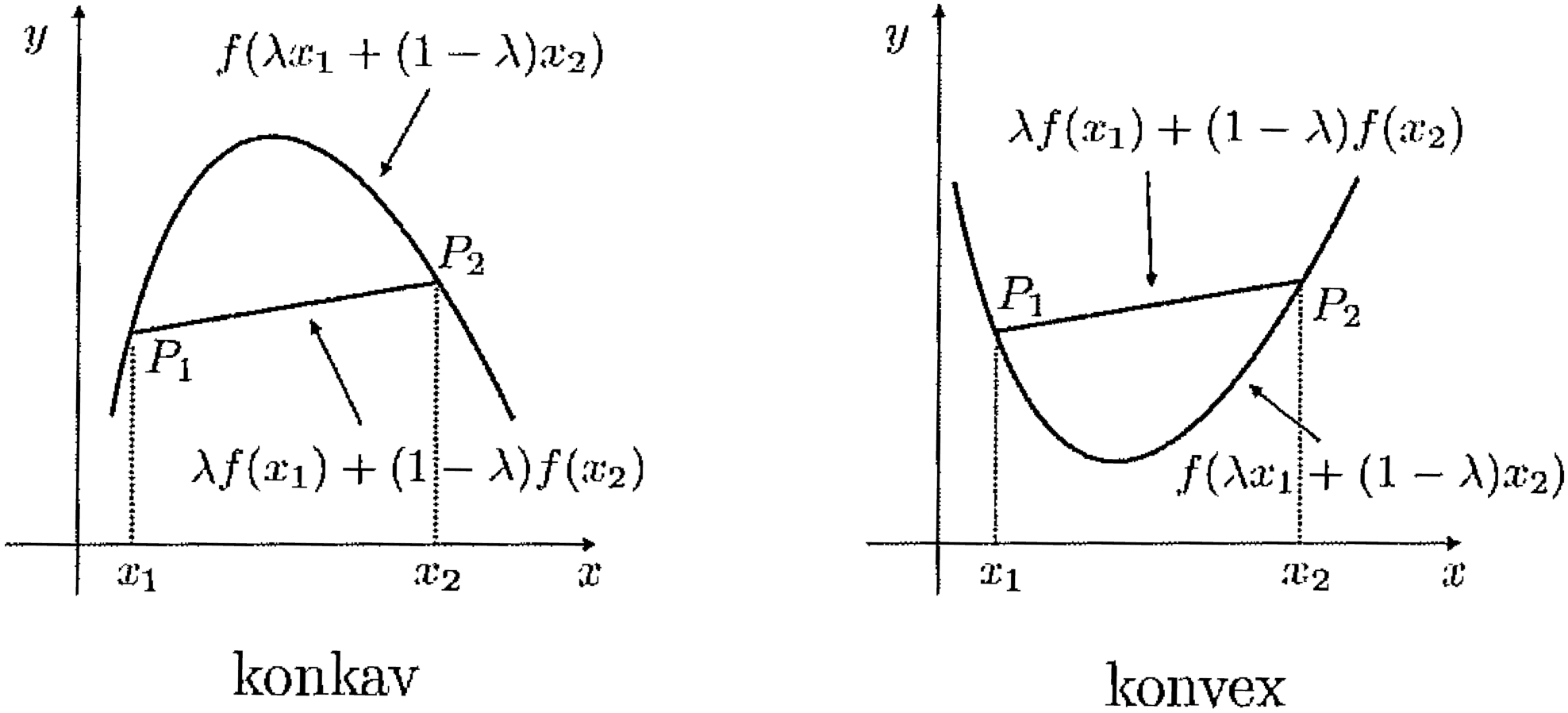
A function f:Ω⊂R→R is called convex if
f(λx1+(1−λ)x2)≤λf(x1)+(1−λ)f(x2)holds for all x1,x2∈Ω and all λ∈[0,1].
f is called concave if −f is convex, i.e. if
f(λx1+(1−λ)x2)≥λf(x1)+(1−λ)f(x2)holds for all x1,x2∈Ω and all λ∈[0,1].
Satz 6
Let f∈C2(Ω). Then f is convex (concave) if and only if f′′(x)≥0(≤0) for all x∈Ω.
Satz 7 (Jensen; Struwe Satz 5.5.3)
Let f:(a,b)→R be convex. Then for arbitrary points x1,...,xN∈(a,b) and numbers 0≤t1,...,tN≤1 with i=1∑Nti=1 the following inequality holds:
f(i=1∑Ntixi)≤i=1∑Ntif(xi).
Example 3.1 Struwe example 5.5.4
[Comparison of arithmetic and geometric mean]
For all 0<x1,...,xn<∞,0≤α1,...,αn≤1 with i=1∑nαi=1 we have:
i=1∏nxiαi≤i=1∑nαixi Show solutionHide solution
Proof:
The statement follows from Satz 5.5.3 (Jensen).
Since exp′′=exp>0 ⟹Satz 6 the function exp is convex. We will use this property below:
i=1∏nxiαi=i=1∏nexp(αilog(xi))=exp(i=1∑nαilog(xi))≤Satz 5.5.3 Jenseni=1∑nαiexp(log(xi))=i=1∑nαixi□