Study Guides / Calculus I / Exercise session 8
EXERCISE SESSION 8 · ETH ZURICH · FS20 · calculus

Uniform Continuity and Uniform Convergence

Compactness, continuity, uniform continuity, Lipschitz continuity, convergence, trigonometric identities

SB
Steven Battilana Quant · ex-ETH

Continuity (II)

Definition 1.1 (Struwe 4.2.2)

K⊂RnK \subset \mathbb{R}^n is called compact if every sequence (xn)n∈N⊂K(x_n)_{n \in \mathbb{N}} \subset K has an accumulation point in KK, i.e. if there exist a subsequence Λ⊂N\Lambda \subset \mathbb{N} and an x0∈Kx_0 \in K with

xn→n→∞,  n∈Λx0.x_n \xrightarrow{n \to \infty, \; n \in \Lambda} x_0.
Remark

A set K⊂RnK \subset \mathbb{R}^n is called compact if it is bounded and closed.

Example 1.1 Struwe 4.2.2
  1. The "closed" interval [0,1][0, 1] is compact.
  2. The "open" interval (0,1)(0, 1) is not compact.

The proofs are in Struwe’s lecture notes.

Continuity

Definition 1.2 (Struwe 4.1.3)

Let Ω⊂Rd,  f:Ω→Rn\Omega \subset \mathbb{R}^d, \; f: \Omega \to \mathbb{R}^n.

  1. ff is called continuous at the point x0∈Ωx_0 \in \Omega if lim⁡x→x0f(x)=f(x0)=:a\lim\limits_{x \to x_0} f(x) = f(x_0) =: a exists.
  2. ff is called continuously extendable at the point x0∈Ω‾∖Ωx_0 \in \overline{\Omega} \setminus \Omega if lim⁡x→x0f(x)=:a\lim\limits_{x \to x_0} f(x) =:a exists.
    (In this case the function ff extended by f(x0)=af(x_0) = a is continuous at the point x0x_0.)
Definition 1.3 (Struwe 4.2.1)

Let f:Ω⊂Rd→Rnf: \Omega \subset \mathbb{R}^d \to \mathbb{R}^n.
ff is called continuous on Ω\Omega if ff is continuous at every point x0∈Ωx_0 \in \Omega.

Definition 1.4 (Burger 3.2.1)

Let D⊂R,x0∈DD \subset \mathbb{R}, x_0 \in D. The function f:D→Rf: D \to \mathbb{R} is continuous at x0\boldsymbol{x_0} if for every ε>0\varepsilon > 0 there is a δ>0\delta > 0 such that for all x∈Dx \in D the implication

∣x−x0∣<δ⟹∣f(x)−f(x0)∣<ε|x - x_0| < \delta \Longrightarrow |f(x) - f(x_0)| < \varepsilon

holds.

Definition 1.5 (Burger 3.2.1 (quantifier version of the above))

Let D⊂R,x0∈DD \subset \mathbb{R}, x_0 \in D. The function f:D→Rf: D \to \mathbb{R} is continuous at x0\boldsymbol{x_0} if

∀ε>0,∃δ>0:∣x−x0∣<δ⟹∣f(x)−f(x0)∣<ε,∀x∈D\forall \varepsilon > 0, \exists \delta > 0: \qquad |x - x_0| < \delta \Longrightarrow |f(x) - f(x_0)| < \varepsilon, \quad \forall x \in D

holds.

Uniform Continuity

Definition 1.6 (Struwe 4.7.2)

f:Ω→Rnf: \Omega \to \mathbb{R}^n is called uniformly continuous if

∀ε>0,  ∃δ(ε)=δ>0,  ∀x,y∈Ω:∣x−y∣<δ⇒∣f(x)−f(y)∣<ε\forall \varepsilon >0, \; \exists \delta(\varepsilon)=\delta >0, \; \forall x,y \in \Omega: \qquad |x-y| < \delta \Rightarrow |f(x)-f(y)| < \varepsilon
Satz 1 (Struwe 4.7.3)

Let Ω⊂Rd\Omega \subset \mathbb{R}^d be bounded, f:Ω→Rnf: \Omega \to \mathbb{R}^n continuous and continuously extendable to Ω‾\overline{\Omega}. Then ff is uniformly continuous.

Satz 2

Let f:Ω→Rf: \Omega \to \mathbb{R} be continuous and Ω\Omega compact. Then ff is uniformly continuous.

Remark

You can remember this theorem with the following rule of thumb:

continuity on a compact set⇒uniform continuity.\text{continuity on a compact set} \quad \Rightarrow \quad \text{uniform continuity}.
Example 1.2

Is the function f:[0,∞)→Rf: [0,\infty) \to \mathbb{R}, f(x)=x2x+1f(x) = \frac{x^2}{x+1} uniformly continuous?

Show solutionHide solution

We fix an ε>0\varepsilon >0. We are looking for δ>0\delta >0 such that for all x,y∈Ωx,y \in \Omega with ∣x−y∣<δ|x-y| < \delta the following holds:

∣f(x)−f(y)∣<ε.|f(x) - f(y)| < \varepsilon.

For x,y∈[0,∞)x,y \in [0,\infty) we have:

∣x2x+1−y2y+1∣=∣x2(y+1)−y2(x+1)(x+1)(y+1)∣=∣x2y+x2−y2x−y2(x+1)(y+1)∣=∣xy(x−y)+x2−y2(x+1)(y+1)∣=∣xy(x−y)+(x−y)(x+y)(x+1)(y+1)∣=∣x−y∣(xy+x+y(x+1)(y+1))=∣x−y∣(xy(x+1)(y+1)+x(x+1)(y+1)+y(x+1)(y+1))\begin{aligned} \left| \frac{x^2}{x+1} - \frac{y^2}{y+1} \right| &= \left| \frac{x^2(y+1) - y^2(x+1)}{(x+1)(y+1)} \right|\\ &= \left| \frac{x^2y+x^2 - y^2x-y^2}{(x+1)(y+1)} \right|\\ &= \left| \frac{xy(x-y) +x^2 -y^2}{(x+1)(y+1)} \right|\\ &= \left| \frac{xy(x-y) +(x-y)(x+y)}{(x+1)(y+1)} \right|\\ &= |x-y| \left( \frac{xy + x+y}{(x+1)(y+1)} \right)\\ &= |x-y| \left( \frac{xy}{(x+1)(y+1)} + \frac{x}{(x+1)(y+1)} + \frac{y}{(x+1)(y+1)} \right) \end{aligned}

Since xx+1≤1\frac{x}{x+1} \leq 1 and yy+1≤1\frac{y}{y+1} \leq 1, we have xy(x+1)(y+1)≤1\frac{xy}{(x+1)(y+1)} \leq 1. Therefore we can make the following estimate:

∣x2x+1−y2y+1∣=∣x−y∣(xy(x+1)(y+1)⏟≤1+x(x+1)(y+1)⏟≤1+y(x+1)(y+1)⏟≤1)≤∣x−y∣(1+1+1)=3∣x−y∣\begin{aligned} \left| \frac{x^2}{x+1} - \frac{y^2}{y+1} \right| &= |x-y| \left( \underbrace{\frac{xy}{(x+1)(y+1)}}_{\leq 1} + \underbrace{\frac{x}{(x+1)(y+1)}}_{\leq 1} + \underbrace{\frac{y}{(x+1)(y+1)}}_{\leq 1} \right)\\ &\leq |x-y| (1+1+1)\\ &= 3|x-y| \end{aligned}

Hence it follows that:

∣x2x+1−y2y+1∣≤3∣x−y∣<!ε⇒∣x−y∣<ε3=:δ.\left| \frac{x^2}{x+1} - \frac{y^2}{y+1} \right| \leq 3|x-y| \stackrel{!}{<} \varepsilon \quad \Rightarrow \quad |x-y| < \frac{\varepsilon}{3} =: \delta.

Since δ\delta is independent of x,yx,y, it follows that ff is uniformly continuous.

Lipschitz Continuity

Definition 1.7 (Struwe 4.1.4)

A function f:Ω⊂Rd→Rnf: \Omega \subset \mathbb{R}^d \to \mathbb{R}^n is called Lipschitz continuous with Lipschitz constant L if

∥f(x)−f(y)∥≤L∥x−y∥,∀x,y∈Ω.\left\lVert f(x)-f(y) \right\rVert \leq L \left\lVert x-y \right\rVert, \quad \forall x,y \in \Omega.
Satz 3

Let Ω⊂R\Omega \subset \mathbb{R} be an interval. A differentiable function f:Ω→Rf: \Omega \to \mathbb{R} is Lipschitz continuous if and only if its first derivative is bounded on Ω\Omega.

Remark

The different kinds of continuity depend on each other as follows, where the arrows represent implications:

f differentiable f Lipschitz continuous f uniformly continuous f continuous bounded derivative Ω compact
Example 1.3

Is the following function Lipschitz continuous? If so, determine the Lipschitz constant.

f:(−3,2)→Rx↦f(x)=x2+4x−1.\begin{aligned} f: (-3,2) &\to \mathbb{R}\\ x &\mapsto f(x) = x^2+4x-1. \end{aligned}
Show solutionHide solution

Let x,y∈(−3,2)x,y \in (-3,2) be arbitrary. We have

∣f(x)−f(y)∣=∣x2+4x−1−(y2+4y−1)∣=∣x2+4x−1−y2−4y+1∣=∣x2+4x−y2−4y∣=∣x2−y2+4(x−y)∣=∣(x−y)(x+y)+4(x−y)∣=∣x+y+4∣∣x−y∣\begin{aligned} |f(x) -f(y)| &= |x^2 + 4x -1 -(y^2+4y-1)|\\ &= |x^2 + 4x -1 -y^2-4y+1|\\ &= |x^2 + 4x -y^2-4y|\\ &= |x^2 -y^2 + 4(x-y)|\\ &= |(x -y)(x+y) + 4(x-y)|\\ &= |x+y +4||x-y| \end{aligned}

For all x,y∈(−3,2)x,y \in (-3,2), the triangle inequality gives ∣x+y+4∣≤∣x∣+∣y∣+4≤3+3+4=10|x+y +4| \leq |x| + |y| + 4 \leq 3+3+4 = 10. We therefore obtain:

∣f(x)−f(y)∣=∣x+y+4∣∣x−y∣≤10∣x−y∣.|f(x) -f(y)| = |x+y +4||x-y| \leq 10 |x-y|.

The function is consequently Lipschitz continuous with Lipschitz constant L=10L=10.

Pointwise and Uniform Convergence

Definition 2.1 (Struwe 4.8.1)

Let Ω⊂Rd\Omega \subset \mathbb{R}^d and let f,  fk:Ω→Rn,  k∈Nf, \; f_k: \Omega \to \mathbb{R}^n, \; k \in \mathbb{N}.

  1. The sequence (fk)k∈N(f_k)_{k \in \mathbb{N}} converges pointwise to ff if

    fk(x)→k→∞f(x),∀x∈Ω.f_k(x) \xrightarrow{k \to \infty} f(x), \quad \forall x \in \Omega.
  2. The sequence (fk)k∈N(f_k)_{k \in \mathbb{N}} converges uniformly to f,  fk→unif.,    k→∞ff, \; f_k \xrightarrow{unif., \;\; k \to \infty} f, if

    sup⁡x∈Ω∣fk(x)−f(x)∣→k→∞0.\sup_{x \in \Omega} | f_k(x) - f(x)| \xrightarrow{k \to \infty} 0.
Satz 4 (Burger 3.7.4)

Let Ω⊂R\Omega \subset \mathbb{R} and let fn:Ω→Rf_n: \Omega \to \mathbb{R} be a sequence of functions consisting of functions continuous (in Ω\Omega) that converges uniformly (in Ω\Omega) to a function f:Ω→Rf: \Omega \to \mathbb{R}.
Then ff is continuous (in Ω\Omega).

Satz 5 (Struwe 4.8.1 (first variant))

Let fk:Ω⊂Rd→Rnf_k: \Omega \subset \mathbb{R}^d \to \mathbb{R}^n be continuous, k∈Nk \in \mathbb{N}. Further, let fk→unif.    k→∞ff_k \xrightarrow{unif. \;\; k \to \infty} f for some f:Ω→Rnf: \Omega \to \mathbb{R}^n. Then ff is continuous.

Satz 6 (second variant)

Let fn:Ω⊂R→Rf_n: \Omega \subset \mathbb{R} \to \mathbb{R} be a sequence of continuous functions. If fnf_n converges uniformly to ff, then ff is continuous.

Remark

Usually the negation of the above theorem is used:
If the pointwise limit ff of fnf_n is discontinuous, then fnf_n does not converge uniformly to ff.

Satz 7 (Dini)

Let fn:Ω⊂Rk→Rmf_n: \Omega \subset \mathbb{R}^k \to \mathbb{R}^m be a sequence of continuous functions with pointwise limit ff and let Ω\Omega be compact. If ff is continuous and fnf_n is monotonically increasing, then fnf_n converges uniformly to ff.

Remark

A monotonically increasing sequence of continuous functions means a sequence fn(x)f_n(x) for which fn(x)≤fn+1(x)f_n(x) \leq f_{n+1}(x) holds for all x∈Ωx \in \Omega.
In other words: for an arbitrary but fixed x∈Ωx \in \Omega we have fn(x)≤fn+1(x)f_n(x) \leq f_{n+1}(x).

Remark Recipe for uniform convergence

Given: a sequence of continuous functions fn:Ω⊂R→Rf_n: \Omega \subset \mathbb{R} \to \mathbb{R}
Asked: does fnf_n converge uniformly on Ω\Omega?

  1. Compute the pointwise limit of fnf_n on Ω\Omega (Struwe Def. 4.8.1 (i)), i.e.

    f(x)=lim⁡n→∞fn(x)for a fixed but arbitrary x∈Ω.f(x) = \lim_{n \to \infty} f_n(x) \quad \text{for a fixed but arbitrary } x \in \Omega.
  2. Check fnf_n for uniform convergence.

    Direct method:

    1. Compute

      sup⁡x∈Ω∣fn(x)−f(x)∣.\sup_{x \in \Omega} | f_n(x) - f(x)|.

      For this purpose it is often useful to compute the derivative of ∣fn(x)−f(x)∣| f_n(x) - f(x)| with respect to xx and set it equal to zero. Unless you can see the maximum directly, but that only works for "simple" problems.

    2. Compute the limit for n→∞n \to \infty

      lim⁡n→∞sup⁡x∈Ω∣fn(x)−f(x)∣.\lim_{n \to \infty} \sup_{x \in \Omega} | f_n(x) - f(x)|.

      If lim⁡n→∞sup⁡x∈Ω∣fn(x)−f(x)∣=0\lim\limits_{n \to \infty} \sup\limits_{x \in \Omega} |f_n(x) - f(x)| = 0, then fnf_n is uniformly convergent on Ω\Omega.

    Indirect methods:

    • ff discontinuous ⇒\Rightarrow no uniform convergence.
    • ff continuous, fn(x)≤fn+1(x)    ∀x∈Ωf_n(x) \leq f_{n+1}(x) \;\; \forall x \in \Omega and Ω\Omega compact ⇒\Rightarrow uniform convergence.
Example 2.1

Consider the sequence of continuous functions defined by

fn:R→R,    fn(x)=∣x∣+1n3.f_n: \mathbb{R} \to \mathbb{R}, \;\; f_n(x) = \sqrt{|x| + \frac{1}{n^3}}.

Does fnf_n converge uniformly on R\mathbb{R}?

Show solutionHide solution
  1. Pointwise convergence: we fix x∈Rx \in \mathbb{R} and take the limit for n→∞n \to \infty:

    lim⁡n→∞fn(x)=lim⁡n→∞∣x∣+1n3=∣x∣=:f(x)\lim_{n \to \infty} f_n(x) = \lim_{n \to \infty} \sqrt{|x| + \frac{1}{n^3}} = \sqrt{|x|} =: f(x)

    The sequence of functions therefore converges pointwise to the pointwise limit f(x)=∣x∣f(x) = \sqrt{|x|}.

  2. Uniform convergence: we have to show that lim⁡n→∞sup⁡x∈R∣fn(x)−f(x)∣=0\lim\limits_{n \to \infty} \sup\limits_{x \in \mathbb{R}} |f_n(x) -f(x)| = 0 holds. We first compute the expression sup⁡x∈R∣fn(x)−f(x)∣\sup\limits_{x \in \mathbb{R}} |f_n(x) -f(x)|:

    sup⁡x∈R∣fn(x)−f(x)∣=sup⁡x∈R∣∣x∣+1n3−∣x∣∣=sup⁡x∈R∣(∣x∣+1n3−∣x∣)(∣x∣+1n3+∣x∣)(∣x∣+1n3+∣x∣)∣=sup⁡x∈R∣1n3∣x∣+1n3+∣x∣∣.\begin{aligned} \sup_{x \in \mathbb{R}} |f_n(x) -f(x)| &= \sup_{x \in \mathbb{R}} \left| \sqrt{|x| + \frac{1}{n^3}} - \sqrt{|x|} \right|\\ &= \sup_{x \in \mathbb{R}} \left| \left( \sqrt{|x| + \frac{1}{n^3}} - \sqrt{|x|} \right) \frac{\left( \sqrt{|x| + \frac{1}{n^3}} + \sqrt{|x|} \right)}{\left( \sqrt{|x| + \frac{1}{n^3}} + \sqrt{|x|} \right)} \right|\\ &= \sup_{x \in \mathbb{R}} \left| \frac{\frac{1}{n^3}}{\sqrt{|x| + \frac{1}{n^3}} + \sqrt{|x|}} \right|. \end{aligned}

    Since ∣x∣|x| is positive, the supremum of ∣1n3∣x∣+1n3+∣x∣∣\left| \frac{\frac{1}{n^3}}{\sqrt{|x| + \frac{1}{n^3}} + \sqrt{|x|}} \right| is attained at x=0x=0. We therefore have:

    sup⁡x∈R∣fn(x)−f(x)∣=sup⁡x∈R∣1n3∣x∣+1n3+∣x∣∣=1n31n3=1n31n32=1n3n321=1n3−32=1n32\begin{aligned} \sup_{x \in \mathbb{R}} |f_n(x) -f(x)| &= \sup_{x \in \mathbb{R}} \left| \frac{\frac{1}{n^3}}{\sqrt{|x| + \frac{1}{n^3}} + \sqrt{|x|}} \right|\\ &= \frac{\frac{1}{n^3}}{\sqrt{\frac{1}{n^3}}}\\ &= \frac{\frac{1}{n^3}}{\frac{1}{n^{\frac{3}{2}}}}\\ &= \frac{1}{n^3} \frac{n^\frac{3}{2}}{1}\\ &= \frac{1}{n^{3-\frac{3}{2}}}\\ &= \frac{1}{n^{\frac{3}{2}}} \end{aligned}

    We now take the limit for n→∞n \to \infty and find:

    lim⁡n→∞sup⁡x∈R∣fn(x)−f(x)∣=lim⁡n→∞1n32=0.\lim_{n \to \infty} \sup_{x \in \mathbb{R}} |f_n(x) -f(x)| = \lim_{n \to \infty} \frac{1}{n^{\frac{3}{2}}} = 0.

Hence the sequence of functions fnf_n converges uniformly to ff on R\mathbb{R}.

Trigonometric Functions

Definition 3.1
tan⁡(x)=sin⁡(x)cos⁡(x).\tan(x) = \frac{\sin(x)}{\cos(x)}.
Remark trigonometric identities
  1. sin⁡(π2−x)=cos⁡(x)\sin(\frac{\pi}{2} - x) = \cos(x)
  2. sin⁡(π−x)=sin⁡(x)\sin(\pi - x) = \sin(x)
  3. sin⁡(2x)=2sin⁡(x)cos⁡(x)\sin(2x) = 2 \sin(x) \cos(x)
  4. ∀x,y∈R\forall x,y \in \mathbb{R}:

    • sin⁡(x±y)=sin⁡(x)cos⁡(y)±cos⁡(x)sin⁡(y)\sin(x \pm y) = \sin(x)\cos(y) \pm \cos(x)\sin(y)
    • cos⁡(x±y)=cos⁡(x)cos⁡(y)∓sin⁡(x)sin⁡(y)\cos(x \pm y) = \cos(x)\cos(y) \mp \sin(x)\sin(y)
Remark should go on your exam summary sheet

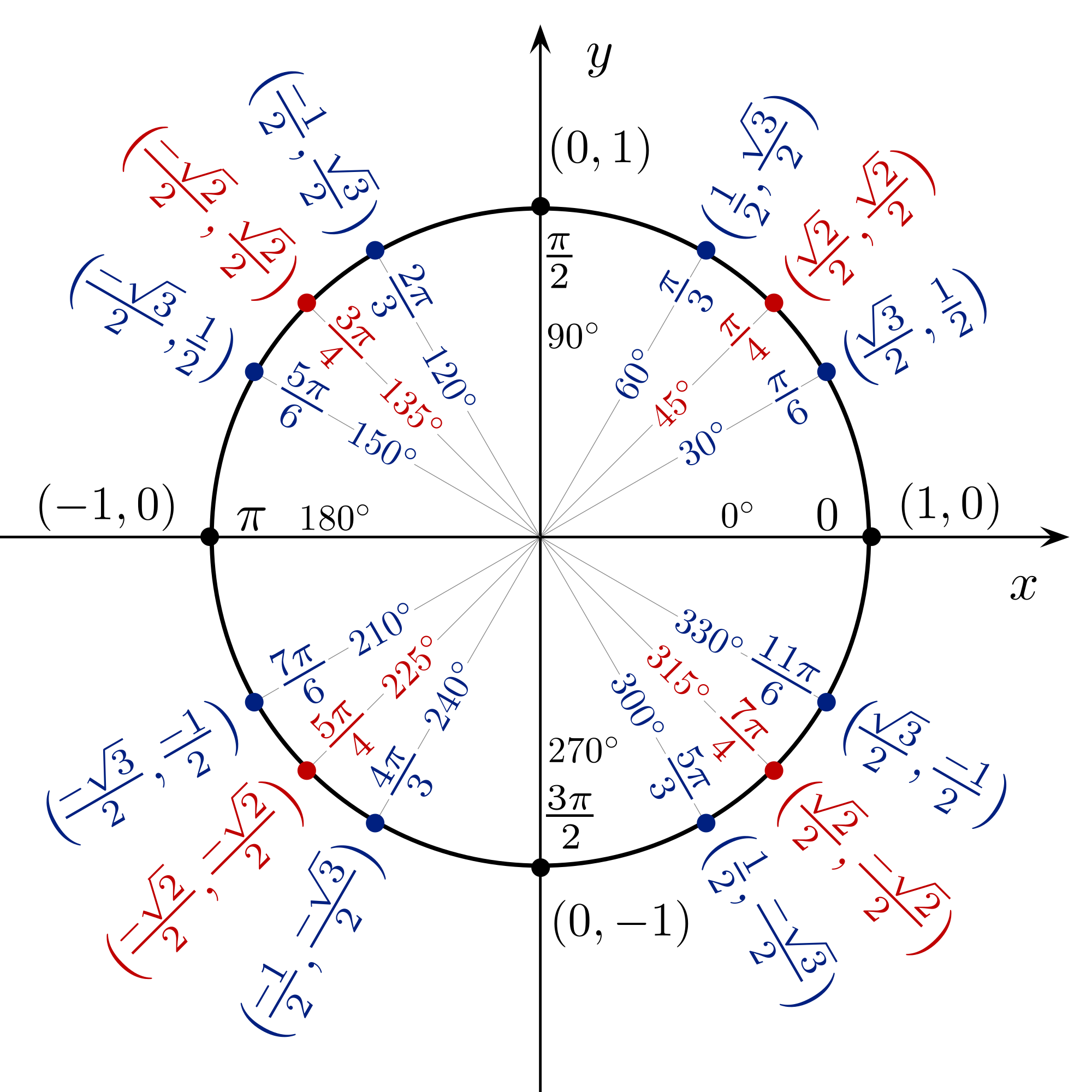
Below you can see "nice" cosine and sine values on the unit circle, where the xx-direction corresponds to cos⁡(x)\cos(x) and the yy-direction to sin⁡(x)\sin(x):

Unit circle with the nice cosine and sine values