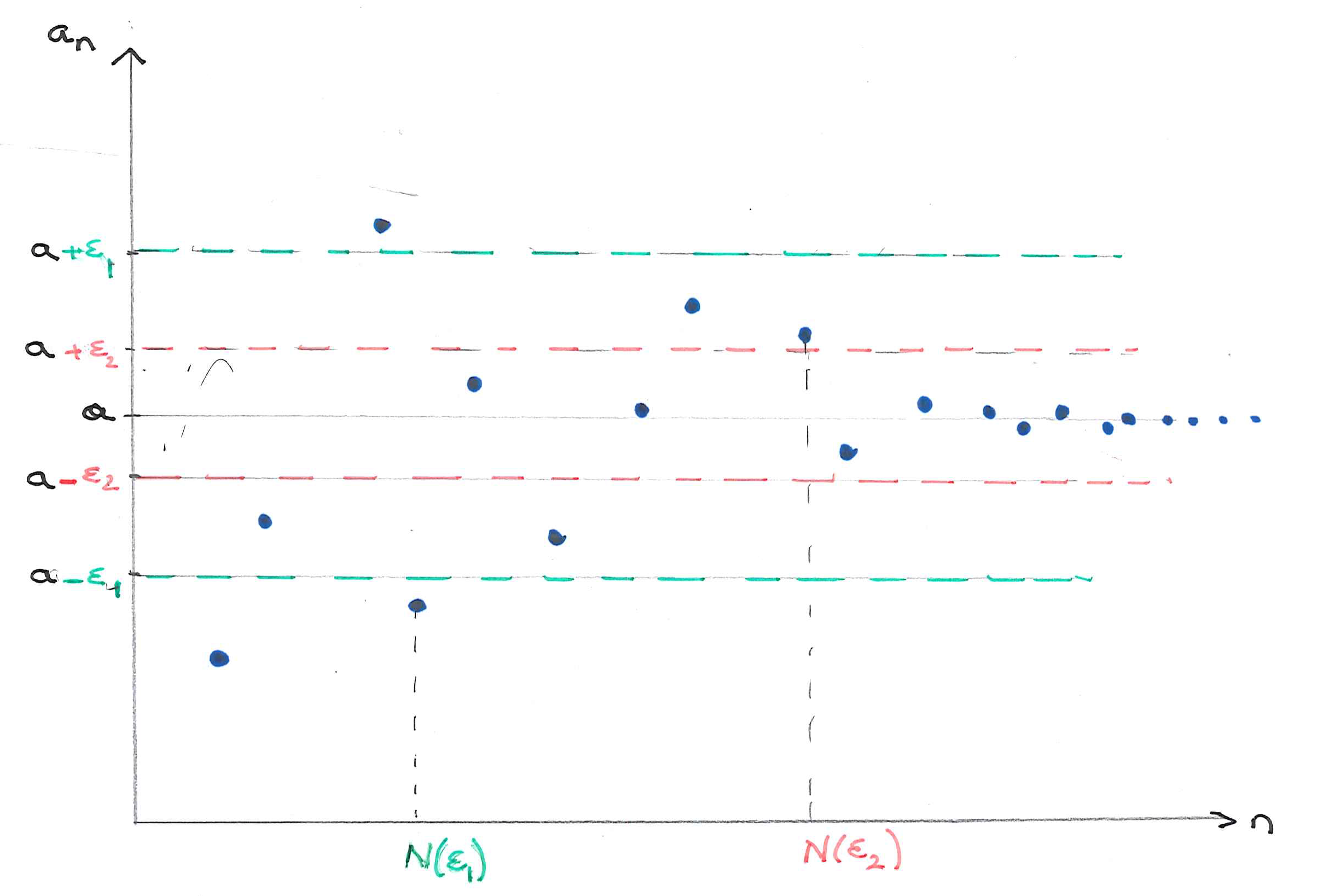
To show: prove with the definition that the following holds: limn→∞n1=0
Show solutionHide solution
Proof:
We choose an arbitrarily small ε>0 (e.g. ε=10−5 or ε=10−10). By the definition, we have to show that there exists an N=N(ε)∈N such that for all n>N the following holds:
∣an−a∣=n1−0=n1<ε.
How do you do that? We solve for n
∣an−a∣=n1<!ε⇒n>0n>ε1.
We therefore choose N:=⌈ε1⌉, where ⌈⋅⌉ is the ceiling function (e.g. ⌈123.12⌉ = 124). Hence for n>N we have (by construction):
n1−0<ε.
This is exactly the definition of limn→∞n1=0.
Satz
If a limit exists, it is unique.
Computing with Limits
Remarkdominance
The following dominance relations hold:
For x→∞:1≤log(x)≤x≤xn(for n≥21)≤nx(for n>1)≤x!≤xx
For x→0:log(x)≤xn≤xn1
Satzrules for limits
If (an)n∈N and (bn)n∈N are convergent with limits a and b respectively, then:
Since neither the denominator nor the numerator converges, the third rule (iii) cannot be applied directly. We have to rewrite the terms as follows to get around the problem.
A sequence (an)n∈N is called monotonically increasing if for all n∈N:
an+1≥an.
Definition 3.2
A sequence (an)n∈N is called strictly monotonically increasing if for all n∈N:
an+1>an.
Definition 3.3
A sequence (an)n∈N is called monotonically decreasing if for all n∈N:
an+1≤an.
Definition 3.4
A sequence (an)n∈N is called strictly monotonically decreasing if for all n∈N:
an+1<an.
Remark
To show monotonicity, you can proceed as follows: replace n by the continuous variable x and compute the derivative with respect to x. If a′(x)≥0 or a′(x)≤0 respectively, the sequence is monotonically increasing or monotonically decreasing respectively.
Remark
Another option is to show directly that anan+1>1 (only if an>0 for all n) or an+1−an>0, analogously for the other cases.
Definition 3.5(3.3.1.)
(an)n∈N is called bounded above (below) if
∃b∈R,∀n∈N:an≤b(or b≤an);
that is, if the set A={an∣n∈N} is bounded above (below).
Satz(3.3.1.)
If (an)n∈N is convergent, then (an)n∈N is bounded.
Remark
Boundedness is therefore necessary, but not sufficient, for convergence, as the example of the sequence an=(−1)n,n∈N, shows.
Boundedness:
We show by induction that an≤2∀n∈N. (Assuming a limit exists, you can compute it with the last step, but then you still have to show boundedness.)
Base case(n=0):
a0=0≤2✓
Induction step(n↦n+1):
We assume that an≤2 holds for a fixed but arbitrary n∈N (induction hypothesis, IH). It follows that
an+1=4an2+1≤IH,0≤an422+1=2.
(0≤an holds, since a0=0 and an+1=4an2+1≥1.)
Now we can apply the monotone convergence theorem. It follows that an converges, i.e. n→∞liman=a. Now we compute the limit a.