Study Guides / Calculus I / Exercise session 1
EXERCISE SESSION 1 · ETH ZURICH · FS20 · calculus

Complex Numbers, Supremum and Infimum

Archimedean principle, supremum, infimum, complex numbers, quadratic formula

SB
Steven Battilana Quant · ex-ETH

Review: Complex Numbers

Remark

z2+1=0z^2+1=0 is an example of an equation that has no solution in R\mathbb{R}. To find a solution, we therefore extend the field to R2\mathbb{R}^2 and call it the field (covered in more detail in chapter 5, Algebra, of Discrete Mathematics) of complex numbers C\mathbb{C}.

Definition 1.1 imaginary unit
i2=−1i=^ the imaginary unit\begin{aligned} i^2 &= -1\\ i &\mathrel{\hat{=}} \text{ the imaginary unit}\end{aligned}
Definition 1.2 Cartesian form
z=x+iyz = x + iy
Definition 1.3 real and imaginary part
Re(z):=x∈R=^ real partIm(z):=y∈R=^ imaginary part\begin{aligned} Re(z) &:= x \in \mathbb{R} \quad \mathrel{\hat{=}} \text{ real part}\\ Im(z) &:= y \in \mathbb{R} \quad \mathrel{\hat{=}} \text{ imaginary part}\end{aligned}
Definition 1.4 conjugation

The conjugate of z=x+iy∈Cz = x + iy \in \mathbb{C} is

z‾=x−iy∈C.\overline{z} = x - iy \in \mathbb{C}.

Conjugation has the following properties:

(i) For all z=x+iy=(x,y),z∈C=R2z = x + iy = (x,y), z \in \mathbb{C} = \mathbb{R}^2 we have

  • z⋅z‾=(x+iy)⋅(x−iy)=x2−i2y2=x2+y2=∥z∥2.z \cdot \overline{z} = (x + iy) \cdot (x - iy) = x^2 - i^2y^2 = x^2 + y^2 = \left\lVert z \right\rVert ^2.

(ii) For all z1,z2∈Cz_1,z_2 \in \mathbb{C} we have

  • z1+z2‾=z1‾+z2‾\overline{z_1 + z_2} = \overline{z_1} + \overline{z_2};
  • z1z2‾=z1‾ z2‾\overline{z_1z_2} = \overline{z_1}\, \overline{z_2}.
Satz

Further properties of the complex numbers. Let z,w∈Cz, w \in \mathbb{C}; then the following hold:

  1. ∥z⋅w∥=∥z∥⋅∥w∥\Vert z \cdot w \Vert = \Vert z \Vert \cdot \Vert w \Vert
  2. ∥zw∥=∥z∥∥w∥,w≠0\Vert \frac{z}{w} \Vert = \frac{\Vert z \Vert}{\Vert w \Vert}, w \neq 0
  3. ∥z∥=∥z‾∥\Vert z \Vert = \Vert \overline{z} \Vert
  4. ∥z+w∥≤∥z∥+∥w∥\Vert z + w \Vert \leq \Vert z \Vert + \Vert w \Vert (triangle inequality)
Definition 1.5 Euler's formula
eiφ=cos⁡φ+isin⁡φe^{i \varphi} = \cos \varphi + i \sin \varphi
Definition 1.6 polar form

The polar form of z=x+iy∈Cz = x + iy \in \mathbb{C} is (caution: φ∈(−π,π]\varphi \in (-\pi, \pi])

z= reiφ,⇔Euler’s formulaz= r(cos⁡φ+isin⁡φ),with r=∥z∥,x=r cos⁡φ,y=r sin⁡φ.\begin{aligned} z = \,&re^{i \varphi},\\ \overset{\text{Euler's formula}}{\Leftrightarrow} z = \,& r(\cos \varphi + i \sin \varphi),\\ \text{with } &r = \Vert z \Vert,\\ &x = r\, \cos \varphi,\\ &y = r\, \sin \varphi. \end{aligned}φ={arctan⁡(yx),x>0arctan⁡(yx)+π,x<0∧y≥0arctan⁡(yx)−π,x<0∧y<0π2,x=0∧y>0−π2,x=0∧y<0undefined,x=0∧y=0\varphi = \begin{cases} \arctan (\frac{y}{x}), &x>0\\ \arctan (\frac{y}{x}) + \pi, &x<0 \wedge y \geq 0\\ \arctan (\frac{y}{x}) - \pi, &x<0 \wedge y < 0\\ \frac{\pi}{2}, &x = 0 \wedge y > 0\\ -\frac{\pi}{2}, &x = 0 \wedge y < 0\\ \text{undefined}, &x = 0 \wedge y = 0 \end{cases}
Remark

The angle φ′\varphi' in the interval [0,2π)[0, 2\pi) can in principle be computed by first computing the angle in (−π,π](-\pi, \pi] as described above and, only if it is negative, increasing it by 2π2\pi:

φ′={φ+2π,φ<0φ,otherwise.\varphi' = \begin{cases} \varphi + 2\pi, &\varphi < 0\\ \varphi, &\text{otherwise.} \end{cases}
Remark

As an alternative to arctan, φ\varphi can also be computed via sine and cosine:

φ∈[0,π]:cos⁡(φ)=xr⟺φ=arccos⁡(xr)φ∈[−π2,π2]:sin⁡(φ)=yr⟺φ=arcsin⁡(yr)\begin{aligned} \varphi \in [0, \pi]: \quad \cos(\varphi) &= \frac{x}{r} \qquad \Longleftrightarrow \qquad \varphi = \arccos\left(\frac{x}{r}\right)\\ \varphi \in [-\tfrac{\pi}{2}, \tfrac{\pi}{2}]: \quad \sin(\varphi) &= \frac{y}{r} \qquad \Longleftrightarrow \qquad \varphi = \arcsin\left(\frac{y}{r}\right) \end{aligned}
Remark Outlook

z2+1=0z^2 + 1 = 0 is an example of an equation with no solution in R\mathbb{R} that does have solutions in C\mathbb{C} (namely z=±iz = \pm i). More generally, the fundamental theorem of algebra holds: every polynomial

p(z)=zn+an−1zn−1+⋯+a0p(z) = z^n + a_{n-1}z^{n-1} + \cdots + a_0

of degree n≥1n \geq 1 has a root in C\mathbb{C}. That is, unlike R\mathbb{R}, C\mathbb{C} is algebraically closed.

Example 1.1

Compute: 6+7i3−8i\frac{6+7i}{3-8i}

Show solutionHide solution 6+7i3−8i=6+7i3−8i⋅3+8i3+8i=18+21i+48i+56i29−64i2=18+21i+48i−569+64=−38+69i73\frac{6+7i}{3-8i} = \frac{6+7i}{3-8i} \cdot \frac{3+8i}{3+8i} = \frac{18 + 21i + 48i + 56i^2}{9 - 64i^2} = \frac{18 + 21i + 48i - 56}{9 + 64} = \frac{-38+69i}{73}
Example 1.2

Compute the polar form of z=1+iz = 1+i.

Show solutionHide solution r=12+12=2φ=arctan⁡(11)=π4⇒z=2eiπ4\begin{aligned} r &= \sqrt{1^2 + 1^2} = \sqrt{2}\\ \varphi &= \arctan (\frac{1}{1}) = \frac{\pi}{4}\\ &\Rightarrow z = \sqrt{2} e^{i \frac{\pi}{4}} \end{aligned}
Example 1.3

Compute the Cartesian form of 7eiπ37 e^{i \frac{\pi}{3}}.

Show solutionHide solution 7eiπ3=7(cos⁡(π3)+isin⁡(π3))=7⋅12+7⋅32i=72+732i7 e^{i \frac{\pi}{3}} = 7(\cos (\frac{\pi}{3}) + i\sin (\frac{\pi}{3})) = 7 \cdot\frac{1}{2} + 7 \cdot \frac{\sqrt{3}}{2} i = \frac{7}{2} + \frac{7 \sqrt{3}}{2} i
Example 1.4

Sketch the following set in the complex plane:

D:={(22(1+i))n    :    n∈N}D := \left\{ \left(\frac{\sqrt{2}}{2} (1+i) \right)^n \;\; : \;\; n \in \mathbb{N} \right\}
Show solutionHide solution

In polar coordinates (1+i)=2eiπ4(1+i) = \sqrt{2} e^{i \frac{\pi}{4}}, hence

(22(1+i))n=einπ4.\left( \frac{\sqrt{2}}{2} (1+i) \right)^n = e^{i \frac{n \pi}{4}}.

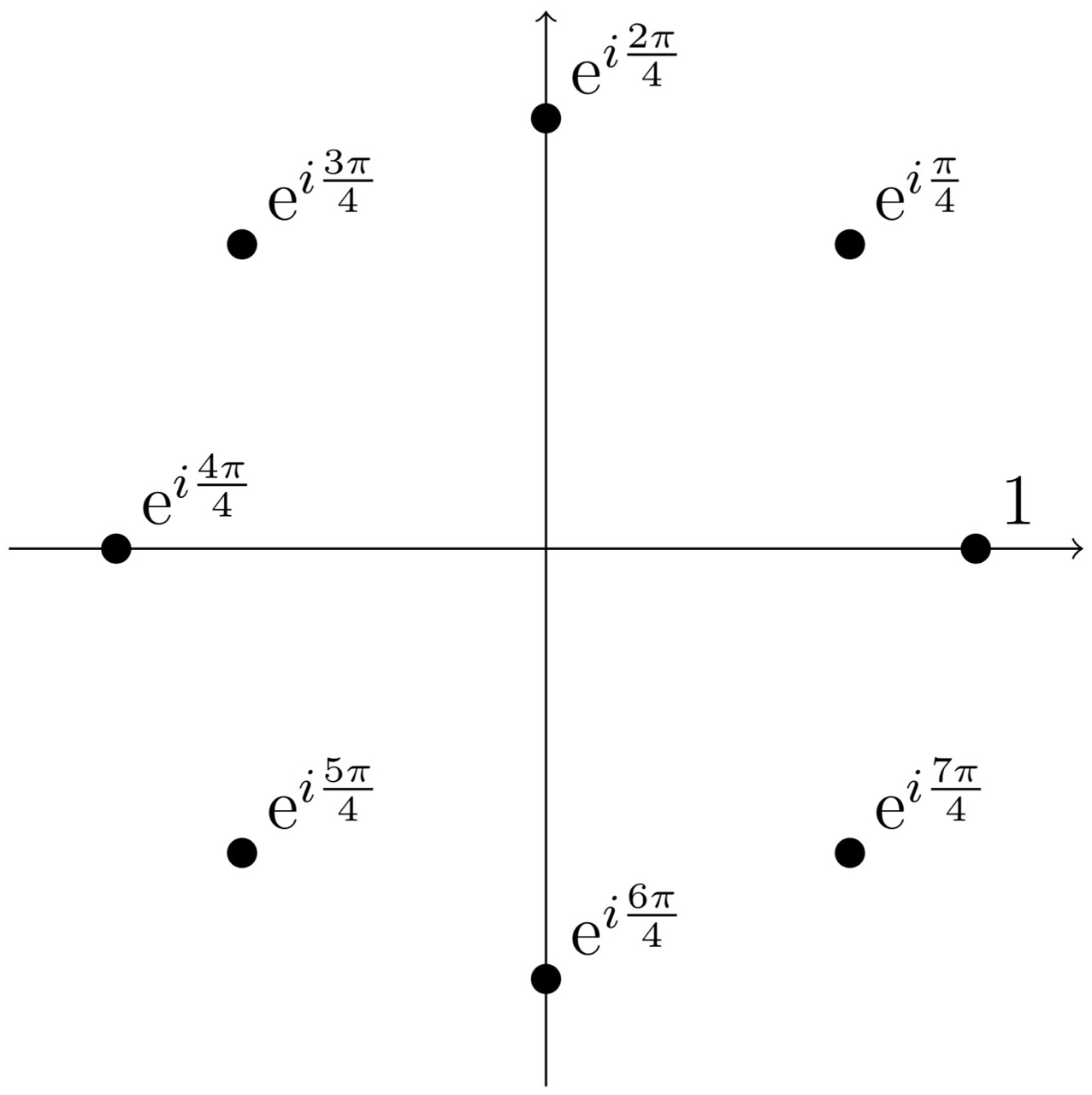
Since eiθ=ei(θ+2kπ)e^{i \theta} = e^{i (\theta + 2k \pi)} ∀k∈Z\quad \forall k \in \mathbb{Z}, DD consists of 8 points, obtained for n=0,1,2,..7n=0,1,2,..7:

D={1,eiπ4,ei2π4,ei3π4,ei4π4,ei5π4,ei6π4,ei7π4}D = \{1, e^{i \frac{\pi}{4}}, e^{i \frac{2\pi}{4}}, e^{i \frac{3\pi}{4}}, e^{i \frac{4\pi}{4}}, e^{i \frac{5\pi}{4}}, e^{i \frac{6\pi}{4}}, e^{i \frac{7\pi}{4}} \}
The eight points of D on the unit circle
Example 1.5

Sketch the following set in the complex plane:

E:={z∈C    :    ∥z−i∥<∥z−1∥}E := \left\{ z \in \mathbb{C} \;\; : \;\; \Vert z - i \Vert < \Vert z - 1 \Vert \right\}
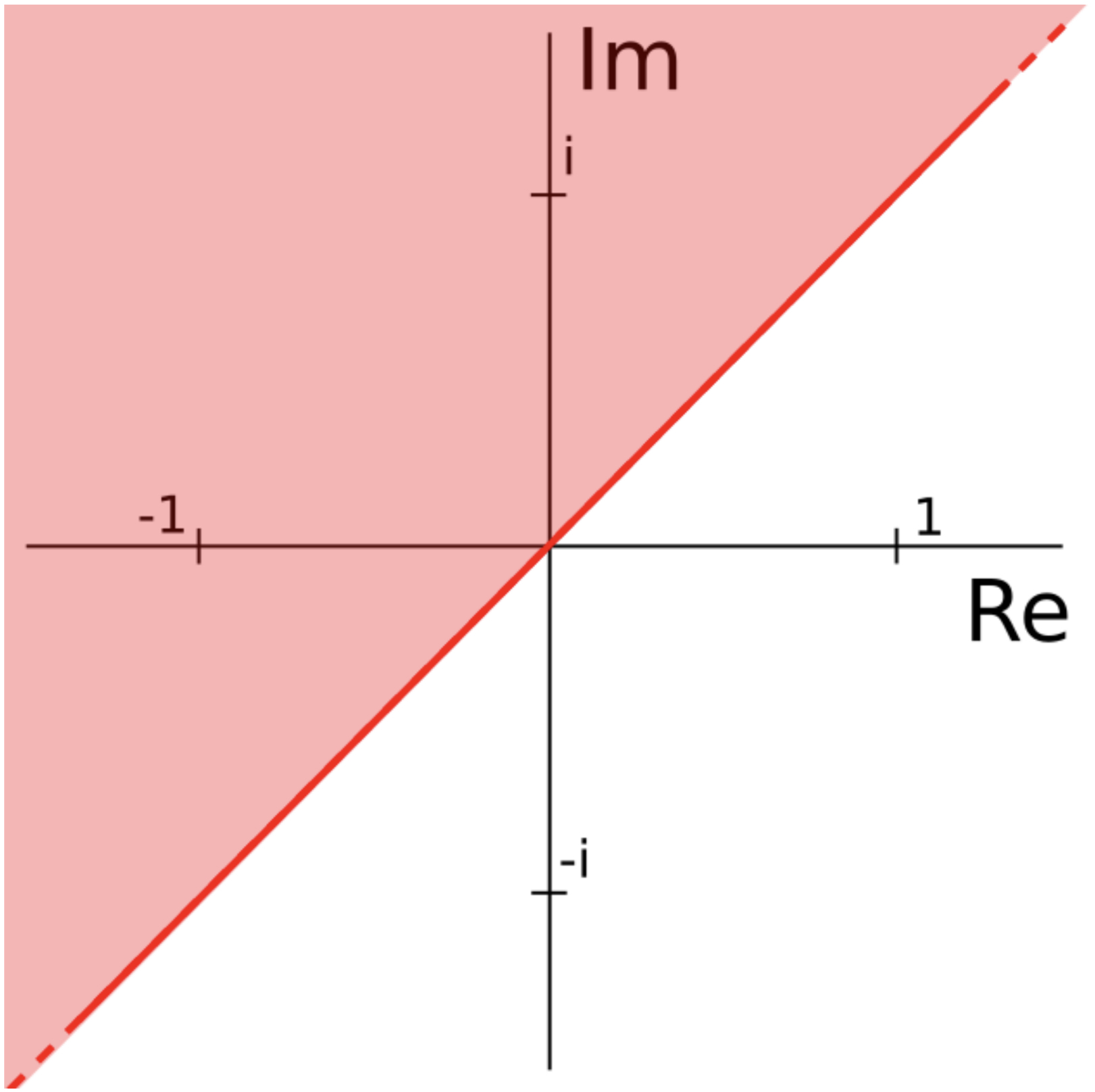
Show solutionHide solution ∥z−i∥<∥z−1∥⟺∥z−i∥2<∥z−1∥2⟺∥x+iy−i∥2<∥x+iy−1∥2⟺∥x+i(y−1)∥2<∥(x−1)+iy∥2⟺(a+ib)(a+ib)‾=∥a+ib∥2=a2+b2x2+(y−1)2<(x−1)2+y2⟺x2+y2−2y+1<x2−2x+1+y2⟺y>x\begin{aligned} \Vert z - i \Vert &< \Vert z - 1 \Vert\\ \Longleftrightarrow \qquad \Vert z - i \Vert^2 &< \Vert z - 1 \Vert^2\\ \Longleftrightarrow \qquad \Vert x + iy - i \Vert^2 &< \Vert x + iy - 1 \Vert^2\\ \Longleftrightarrow \qquad \Vert x + i(y - 1) \Vert^2 &< \Vert (x - 1) + iy \Vert^2\\ \overset{(a + ib)\overline{(a + ib)} = \Vert a + ib \Vert^2 = a^2 + b^2}{\Longleftrightarrow} \qquad x^2 + (y - 1)^2 &< (x - 1)^2 + y^2\\ \Longleftrightarrow \qquad x^2 + y^2 - 2y + 1 &< x^2 - 2x + 1 + y^2\\ \Longleftrightarrow \qquad y &> x \end{aligned}
The half-plane y > x in the complex plane
Remark belongs in your exam summary

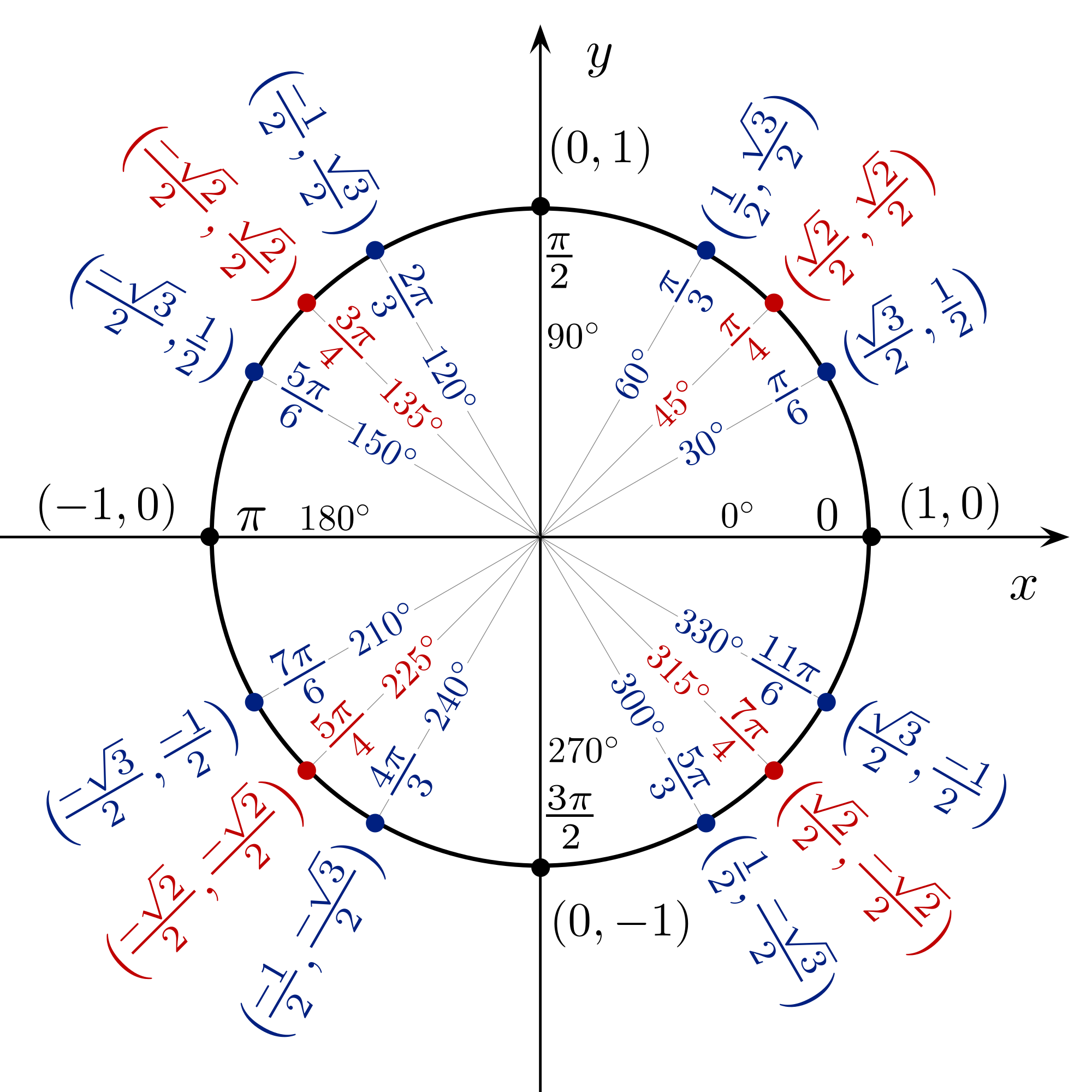
Below you see the "nice" cosine and sine values on the unit circle, where the xx-direction corresponds to cos⁡(φ)\cos(\varphi) and the yy-direction to sin⁡(φ)\sin(\varphi):

Unit circle with the nice cosine and sine values
Remark

Quadratic formula (learn by heart)

ax2+bx+c=0⇒x1,2=−b±b2−4ac2a\begin{aligned} ax^2 + bx + c &= 0\\ \Rightarrow \quad x_{1,2} &= \frac{-b \pm \sqrt{b^2 -4ac}}{2a} \end{aligned}
Example 1.6

Find all solutions of the following equation:

z2−2(3i+eiπ)=0(1)z^2 - 2 \left( \sqrt{3} i + e^{i \pi} \right) = 0 \tag{1}
Show solutionHide solution z2−2(3i+eiπ)=0⟺eiπ=−1z2−2(3i−1)=0⟺z2=2(3i−1)⟺z2=−2+23i⟺z2=4(−12+32i)⟺polar form and Euler’s formula(reiϑ)2=4ei2π3⟺r2e2iϑ=4ei2π3\begin{aligned} z^2 - 2 \left( \sqrt{3} i + e^{i \pi} \right) &= 0\\ \overset{e^{i \pi} = -1}{\Longleftrightarrow} \qquad z^2 - 2 \left( \sqrt{3} i -1 \right) &= 0\\ \Longleftrightarrow \qquad z^2 &= 2 \left( \sqrt{3} i -1 \right)\\ \Longleftrightarrow \qquad z^2 &= - 2 + 2 \sqrt{3} i\\ \Longleftrightarrow \qquad z^2 &= 4 \left( -\frac{1}{2} + \frac{\sqrt{3}}{2}i \right)\\ \overset{\text{polar form and Euler's formula}}{\Longleftrightarrow} \qquad \left(r e^{i \vartheta} \right)^2 &= 4 e^{i \frac{2 \pi}{3}}\\ \Longleftrightarrow \qquad r^2 e^{2 i \vartheta} &= 4 e^{i \frac{2 \pi}{3}} \end{aligned}⟹r=4=2⟹2ϑ=2π3+2kπ,    ∀k∈Z⟺ϑ=π3+kπ,    ∀k∈Z\begin{aligned} \Longrightarrow \qquad r &= \sqrt{4} = 2\\ \Longrightarrow \qquad 2 \vartheta &= \frac{2 \pi}{3} + 2k \pi,\;\; \forall k \in \mathbb{Z}\\ \Longleftrightarrow \qquad \vartheta &= \frac{\pi}{3} + k \pi,\;\; \forall k \in \mathbb{Z} \end{aligned}⟹z=2ei(π3+kπ)for   k=0,1⟺z={2eiπ3,2ei4π3}⟺z={1+3i,−1−3i}\begin{aligned} \Longrightarrow \qquad z &= 2 e^{i \left(\frac{\pi}{3} + k \pi \right)} \qquad \text{for } \; k = 0, 1\\ \Longleftrightarrow \qquad z &= \left\{ 2e^{i \frac{\pi}{3}}, 2e^{i \frac{4\pi}{3}} \right\}\\ \Longleftrightarrow \qquad z &= \left\{ 1 + \sqrt{3} i, -1 - \sqrt{3}i \right\} \end{aligned}

Supremum and Infimum

Theorem 1 Archimedean principle (credit: Olivier Bitter)
  1. (Version 1): ∀b>0  ∃n∈N:b<n\forall b > 0\;\exists n\in \mathbb{N}: b < n "We can always get bigger."
  2. (Version 2): ∀ϵ>0  ∃n∈N:1n<ϵ\forall \epsilon > 0\;\exists n\in \mathbb{N}: \frac{1}{n} < \epsilon "We can always get smaller."
Definition 2.1 upper bound

Let A⊂RA \subset \mathbb{R} be a subset of R\mathbb{R}. A number b∈Rb \in \mathbb{R} is called an upper bound for AA if

∀a∈A:a≤b.\forall a \in A: \quad\quad a \leq b.
Definition 2.2 lower bound

A lower bound for AA is a number c∈Rc \in \mathbb{R} such that

∀a∈A:a≥c.\forall a \in A: \quad\quad a \geq c.
Remark

Note that upper or lower bounds of AA need not be elements of AA. If the subset AA has an upper bound, AA is called bounded above. If a lower bound for AA exists, AA is called bounded below.

Remark

A set AA can have several bounds, i.e. bounds are not unique. If, for instance, bb is an upper bound for AA, then so is every real number greater than bb.

Definition 2.3 supremum, infimum

The supremum of a set AA is the least upper bound of AA (notation: sup⁡(A)\sup(A)). The infimum of AA is the greatest lower bound of AA (notation: inf⁡(A)\inf(A)). If AA is unbounded above and/or below, we set

sup⁡(A)=+∞,inf⁡(A)=−∞.\sup (A) = +\infty, \quad\quad \inf (A) = -\infty.
Remark

While upper and lower bounds are not unique, the supremum and the infimum of a set AA are always unique. The supremum and the infimum need not be elements of AA.

Definition 2.4 maximum, minimum

If sup⁡(A)∈A\sup (A) \in A, then sup⁡(A)\sup (A) is called the maximum of AA, with the following notation:

sup⁡(A)=max⁡(A).\sup (A) = \max (A).

Analogously, if inf⁡(A)∈A\inf (A) \in A, then inf⁡(A)\inf (A) is called the minimum of AA, with the following notation:

inf⁡(A)=min⁡(A).\inf (A) = \min (A).
Definition 2.5

Let B,C⊂RB,C \subset \mathbb{R} be non-empty; then B+CB+C denotes the following set

B+C:={b+c  ∣  b∈B,c∈C}.B+C := \{b+c \;|\; b \in B, c \in C \}.
Satz computing with sup/inf

Let B,C⊂RB,C \subset \mathbb{R} be non-empty; then the following formulas hold:

  1. sup⁡(B+C)=sup⁡(B)+sup⁡(C)\sup (B+C) = \sup (B) + \sup (C)
  2. inf⁡(B+C)=inf⁡(B)+inf⁡(C)\inf (B+C) = \inf (B) + \inf (C)
  3. sup⁡(B∪C)=max⁡{sup⁡(B),sup⁡(C)}\sup (B \cup C) = \max \{\sup (B), \sup (C) \}
  4. inf⁡(B∪C)=min⁡{inf⁡(B),inf⁡(C)}\inf (B \cup C) = \min \{\inf (B), \inf (C) \}.
Algorithm 1 supremum proofs (credit: Olivier Bitter)
  1. Input: a set SS
  2. if S≠∅∧upper bounds(S)≠∅S \neq \emptyset \wedge \text{upper bounds}(S)\neq \emptyset then
  3. "Guess" s+s^+ and claim that "s+∈upper bounds(S)s^+ \in \text{upper bounds}(S)" holds.
  4. Prove the claim by showing that ∀s∈S:s+≥s\forall s\in S: s^+ \ge s.
  5. // Hence we know that sup⁡S\sup S exists.
  6. Now we claim that "s+=sup⁡Ss^+ = \sup S" holds.
  7. if s+∈Ss^+ \in S then
  8. // Proof by demonstration
  9. sup⁡S=max⁡S=s+\sup S = \max S = s^+ and we are done!
  10. else
  11. // Proof by contradiction
  12. Show that s+∉Ss^+ \notin S.
  13. // Hence we know that max⁡S\max S does not exist.
  14. Carry out an ϵ\epsilon-proof, as explained in the following example. Done!
  15. end if
  16. else
  17. SS is either empty or not bounded above; both imply that
  18. sup⁡S\sup S and max⁡S\max S do not exist.
  19. If SS is unbounded above, we have to prove that as well!
  20. end if
Remark credit: Olivier Bitter

An ϵ\epsilon-proof (line 14) is carried out as follows: let ϵ>0\epsilon > 0, and assume for contradiction that s′:=s+−ϵs' := s^+ - \epsilon is another upper bound for SS. Find an element s∈Ss\in S that is strictly greater than s′s', which contradicts our assumption (we assumed that s′s' is an upper bound).

Example 2.1 credit: Olivier Bitter

Given: M1:={1+1n:n∈N−{0}}M_1 := \left\{ 1 + \frac{1}{n}: n \in \mathbb{N} - \left\{ 0\right\}\right\}
Wanted: sup⁡/max⁡\sup/\max and inf⁡/min⁡\inf/\min (if they exist)

We start with sup⁡/max⁡\sup/\max:

  1. (Line 2): It should be obvious that M1≠∅M_1 \neq \emptyset. That upper bounds(M1)≠∅\text{upper bounds}(M_1) \neq \emptyset should also be clear, since the elements decrease as nn grows. We still have to prove this formally (see steps 2 - 5).

  2. (Line 3): We guess m+=2m^+ = 2 and claim that 2∈upper bounds(M1)2 \in \text{upper bounds}(M_1).

  3. (Line 4): ∀n≥1\forall n \ge 1:

    n≥1⇔1≥1n⇔2≥1+1n,n \ge 1 \Leftrightarrow 1 \ge \frac{1}{n} \Leftrightarrow 2 \ge 1 + \frac{1}{n},

    which shows that 2∈upper bounds(M1)2\in \text{upper bounds}(M_1).

  4. (Line 7): Choosing n=1n = 1 gives 1+11=2=m+1 + \frac{1}{1} = 2 = m^+, which shows that m+∈M1m^+ \in M_1.

  5. (Line 9): To summarise: sup⁡M1=max⁡M1=2\sup M_1 = \max M_1 = 2.

Now we compute inf⁡/min⁡\inf/\min:

  1. (Line 2): Again it should be obvious that M1≠∅M_1 \neq \emptyset. It should be intuitively clear that the elements can never become negative, so lower bounds(M1)≠∅\text{lower bounds}(M_1)\neq \emptyset.

  2. (Line 3): We guess m−=1m^- = 1 and claim "1∈lower bounds(M1)1\in \text{lower bounds}(M_1)".

  3. (Line 4): To see that 11 is a lower bound, we use the following equivalences: ∀n≥1\forall n \ge 1:

    1≥0⇔1n≥0⇔1+1n≥1.1 \ge 0 \Leftrightarrow \frac{1}{n} \ge 0 \Leftrightarrow 1 + \frac{1}{n} \ge 1.
  4. (Line 7): As nn grows, the elements seem to get very close to 11 without ever reaching it. So we end up in line 10 and have to carry out a proof by contradiction.

  5. (Line 12): Assume for contradiction that 1∈M11 \in M_1. Then there exists an n≥1n \geq 1 such that

    1=1+1n⇔0=1n⇔0=11 = 1 + \frac{1}{n} \Leftrightarrow 0 = \frac{1}{n} \Leftrightarrow 0 = 1

    which is a contradiction. Hence M1M_1 has no minimum.

  6. (Line 14): Now we want to show that 11 is the greatest lower bound of M1M_1. Assume for contradiction that a greater lower bound exists, m′=m−+εm' = m^- + \varepsilon. But then we would need

    1+ε≤1+1n⇔ε≤1n(∀n≥1).1 + \varepsilon \le 1 + \frac{1}{n} \Leftrightarrow \varepsilon \le \frac{1}{n}\quad (\forall n \ge 1).

    This contradicts Theorem 1 (version 2 of the Archimedean principle). Hence inf⁡M1=1\inf M_1 = 1, and no minimum exists.